Property for Sale in Thailand: Who Is Buying in Phuket in 2026?
Who buys property for sale in Thailand and Phuket in 2026? REIC data on foreign condo buyers by nationality, what...
Read More →



Karon Beach. Photo by กสิณธร ราชโอรส, CC BY-SA 4.0, via Wikimedia Commons, cropped.
The Phuket rainy season runs from about mid-May to mid-October, according to the Thai Meteorological Department (TMD), and the start and end move from year to year. On the department’s own Phuket records, though, November is still wet, with a 30-year mean of 178.2 mm of rain over 15.9 rainy days.
This guide sets out the Phuket rainy season month by month using TMD’s official 1991–2020 averages. It then covers what the wet months mean for daily life in Karon: beach flags, outdoor plans, humidity at home and getting around.
TMD generally divides Thailand’s year into three seasons:
The rainy season comes with the southwest monsoon, which brings cloud and widespread heavy rain, especially on coasts and windward mountains. Phuket sits in TMD’s southern west-coast region. The Land Development Department says rainfall on the southern west coast peaks in September.
You can see the monsoon in the wind as well. At TMD’s Phuket station the prevailing wind blows from the west from May to October and from the northeast from November to January.
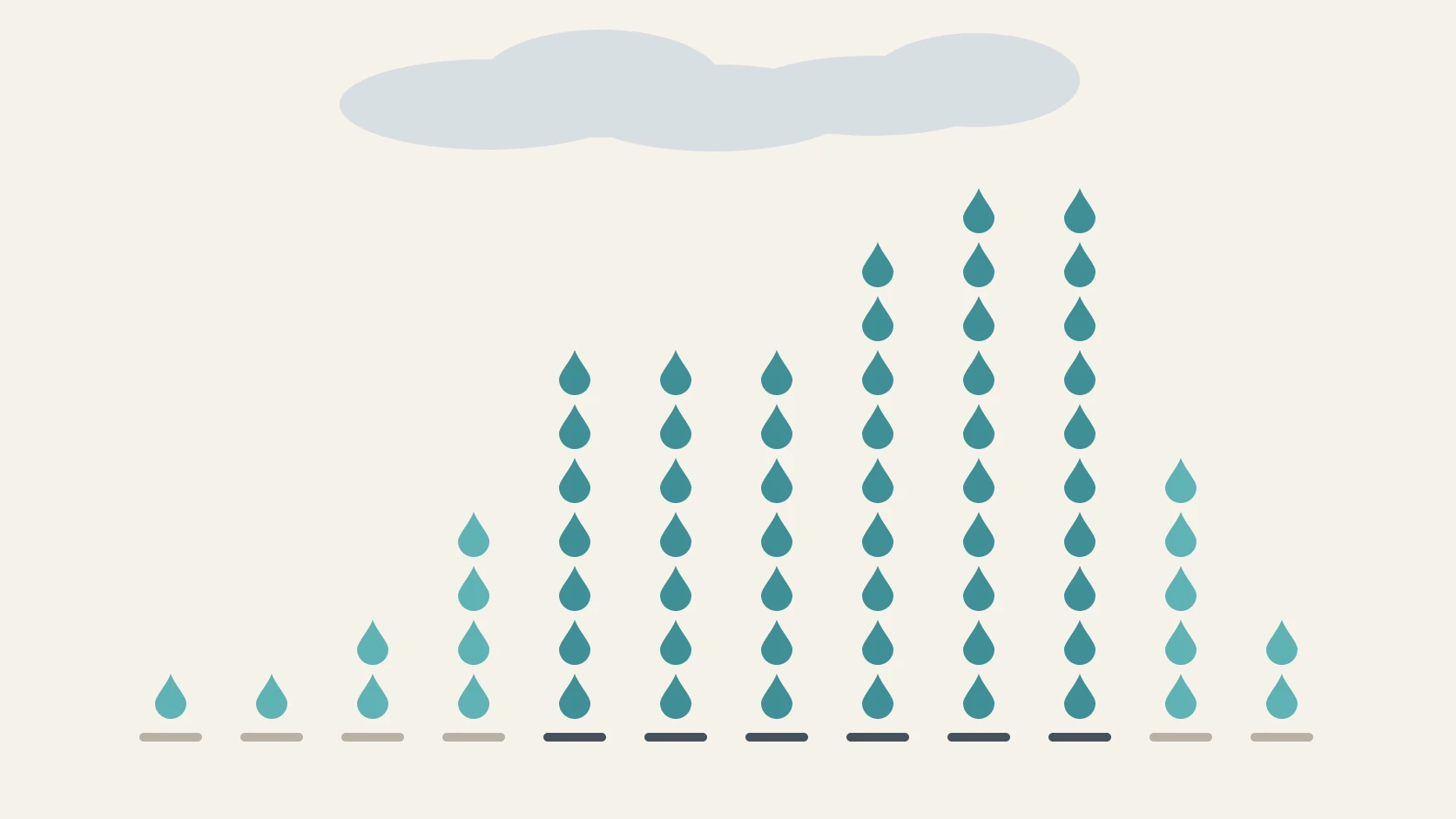
The table shows TMD’s 30-year averages (1991–2020) for its Phuket station: mean monthly rainfall, mean number of rainy days and mean relative humidity.
| Month | Rainfall (mm) | Rainy days | Mean humidity (%) |
|---|---|---|---|
| January | 49.9 | 5.6 | 71 |
| February | 24.0 | 3.4 | 69 |
| March | 80.7 | 7.5 | 71 |
| April | 135.1 | 11.7 | 75 |
| May | 236.9 | 18.9 | 79 |
| June | 249.4 | 18.6 | 79 |
| July | 240.2 | 19.1 | 79 |
| August | 308.7 | 19.5 | 79 |
| September | 350.4 | 21.7 | 81 |
| October | 336.0 | 22.7 | 82 |
| November | 178.2 | 15.9 | 79 |
| December | 82.0 | 10.3 | 75 |
How to read it:
Phuket is warm all year, and the rainy months are slightly cooler in the afternoon. At TMD’s Phuket station the mean daily maximum peaks at 34.4 °C in March and falls to 31.8 °C in September and October. The mean minimum stays between 24.9 °C in October and 26.3 °C in April, so nights are warm in every season.
Humidity rises once the rains arrive. Mean relative humidity is 69% in February and 82% in October, and the mean daily maximum reaches 93% in September and October. Cloud cover goes up with it, from 4.0 out of 10 in February to 7.4 in September.
Karon is an open bay. The Tourism Authority of Thailand (TAT) warns that from May to October the beach may be affected by serious undertows, and asks swimmers and surfers to watch the warning flags, especially at the southern end.
TAT lists four flag signals:
During the monsoon, Phuket authorities put up red flags in Thai, English, Chinese and Russian and ask visitors to stay out of the water while the flags are up. Even water that looks shallow can hold powerful waves.
Sunshine does not mean the sea is safe. The US National Weather Service notes that rip currents often form on calm, sunny days, and advises swimming only at beaches with lifeguards. Save the Thai emergency numbers before you need them: 1669 for Emergency Medical Services and 191 for general emergencies.
For each beach near Karon, including which ones face the swell, read our guide to the beaches near Karon.

Warning flag at Mai Khao Beach, Phuket. Photo by CEphoto, Uwe Aranas, CC BY-SA 4.0, via Wikimedia Commons, cropped.
Rainy-season downpours do not usually last all day. A 2018 TAT guide to the southwest monsoon says rain typically falls for 1–2 hours in the afternoon or early evening, although it is sometimes prolonged.
That makes the morning the easiest time for walks, runs and the beach. Some other habits help in the wet months:
October also brings the Phuket Vegetarian Festival. Our Phuket Vegetarian Festival 2026 guide covers what to expect in the change-over month.
Outdoor humidity at TMD’s Phuket station averages 79% to 82% from May to November. Indoors, the US Environmental Protection Agency advises keeping humidity below 60%, ideally between 30% and 50%, because controlling moisture is how you control mould.
The EPA’s general advice translates easily to a Karon apartment:
If you leave a home empty for part of the wet season, ask whoever manages it to air the rooms and check cupboards. Finishes and furniture make a difference as well, and our guide to condo interior design in a tropical climate covers the ones that cope with humidity.
Allow extra time in heavy rain for anything with a fixed start, such as a flight or a school run. The Phuket Smart Bus route between the airport and Rawai serves Karon and Kata, and the operator notes that its times are approximate and may vary with traffic.
On a scooter, wear a helmet and slow down on wet hills. For airport transfers, our Karon to Phuket Airport transport guide compares the options.
Ever Prime Residences is planned on Patak Road in Karon, with completion expected in December 2028. The date may change; the developer’s latest official announcement takes precedence. According to the developer’s brochure, Kata Beach is 0.9 km and Karon Beach 1.4 km from the project.
On days when red flags are up, the brochure’s facilities list includes double lap swimming pools and an ocean-view rooftop pool. For days when it pours, it lists a fitness centre and yoga, a games room, a golf simulator room, a squash court, a library and a co-working space. The project also plans underground parking.

Computer-generated image
You can see how the three swimming areas fit together in our guide to the pools at Ever Prime Residences.
TMD puts Thailand’s rainy season from mid-May to mid-October, with the dates varying each year. At its Phuket station, November also averages 178.2 mm of rain.
September, with a 30-year mean of 350.4 mm at TMD’s Phuket station. October has the most rainy days, a mean of 22.7.
Usually not. TAT’s 2018 monsoon guide says rain typically lasts 1–2 hours in the afternoon or early evening, but it can be prolonged.
Only when the flags allow it. TAT warns of serious undertows at Karon from May to October. Stay out when red flags are up and swim near lifeguards.
February, with a mean of 24.0 mm and 3.4 rainy days at TMD’s Phuket station.
On TMD’s records the Phuket rainy season peaks in September, November is still wet, and mean humidity stays near 80% through the wet months. Living in Karon through it mostly means swimming when the flags allow, doing outdoor plans in the morning and keeping your home dry.
To see how a home at Ever Prime Residences could work in every season, contact the Ever Prime Residences team for the brochure and current layouts.
Climate figures are 30-year averages (1991–2020) for the Thai Meteorological Department’s Phuket station, from its climatological data report, accessed 29 October 2026. Actual weather varies from year to year, and sea conditions change daily, so always follow beach flags and lifeguards.
All project specifications, facilities and distances are taken from the developer’s brochure and are subject to change without notice.
Image note: Beach photos are credited under each image. The rainfall diagram is an illustration, and the fitness centre image is from the Ever Prime Residences computer-generated renderings, not a photograph of the completed project.