Property for Sale in Thailand: Who Is Buying in Phuket in 2026?
Who buys property for sale in Thailand and Phuket in 2026? REIC data on foreign condo buyers by nationality, what...
Read More →


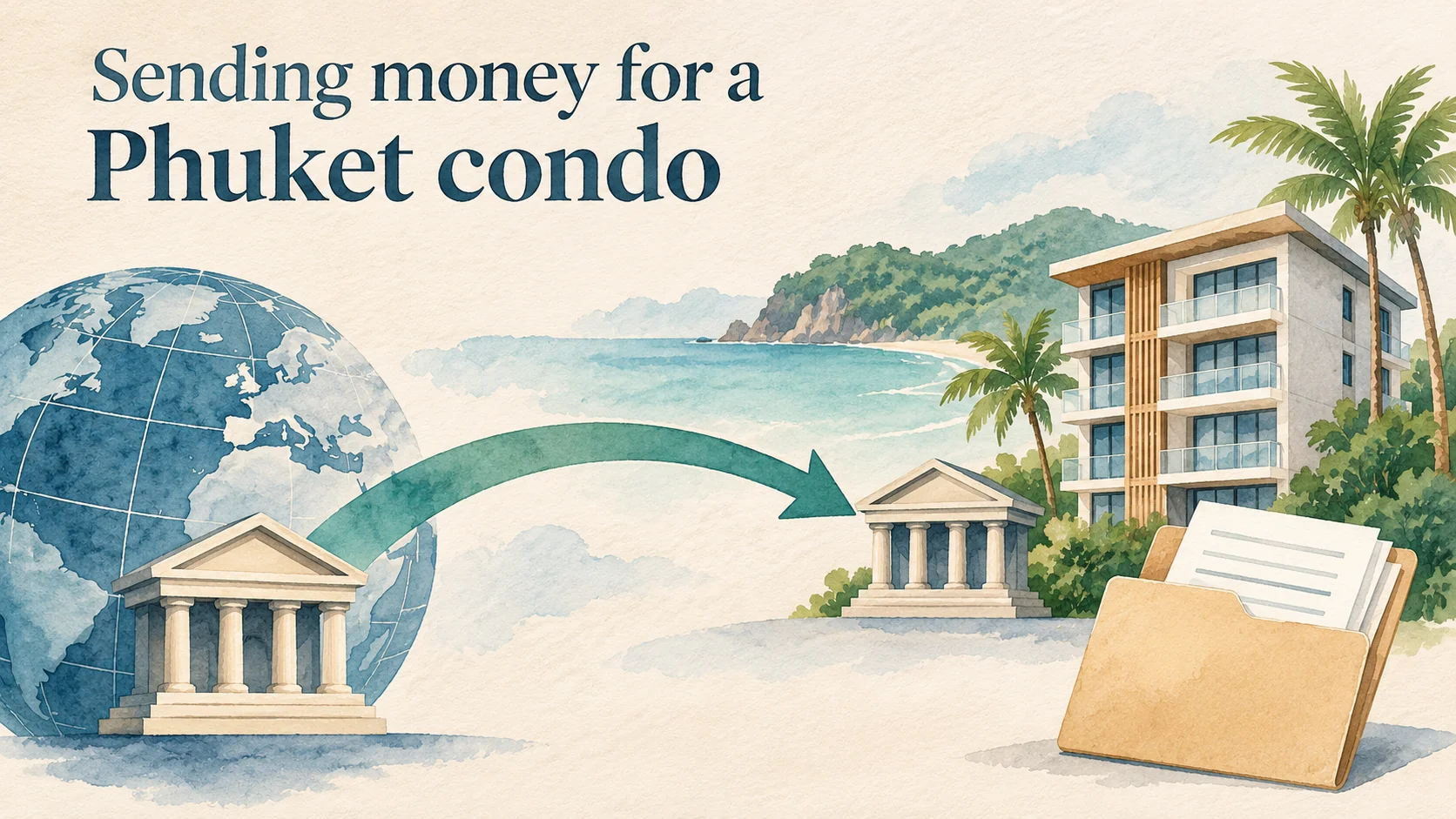
To buy a condo in Phuket in your own name as a foreigner, you normally send the purchase money from abroad in foreign currency, and your Thai bank issues evidence of that transfer. The Land Office asks for that evidence, for at least the price of the unit, before it registers the sale to you.
The bank document is widely called the FET form, short for Foreign Exchange Transaction form, and it has its own entry in our Phuket condo buying glossary.
It is the bank’s record of a foreign exchange transaction. Under the Bank of Thailand’s rules, anyone who buys, sells, deposits or withdraws foreign currency with an authorised bank must give the bank the details of the transaction, and after the transaction the bank issues evidence of it to the customer.
The Bank of Thailand notice on currency exchange says that evidence includes your identification, the amount, the date and the purpose of the transaction, and that it counts as the prescribed form. The Thai government’s information portal calls the document a “Foreign Currency Transaction Form” and says the bank issues it for remittances of USD 50,000 or the equivalent.
Banks name and format the document in different ways; some print the details on a credit advice. For the Land Office, it has to show that the money came into Thailand as foreign currency, in your name, for the condo purchase.
Foreign exchange in Thailand must go through persons licensed by the Minister of Finance, which in practice means a licensed bank.

The Condominium Act lets foreigners own condo units if they fall into one of several groups. One group is foreigners who bring foreign currency into Thailand, or who withdraw money from a non-resident baht account or a foreign currency account.
At the transfer, section 19 ter asks the foreign buyer to show evidence of that money, in an amount not less than the sale price of the unit. The official registers the sale only after checking those documents and confirming that the building’s foreign share stays within the legal limit.
The government portal adds one exception: a foreign buyer with permanent residence in Thailand may buy using Thai baht without the form. Everyone else should plan for it.
Our international buyer checklist for a Phuket condo shows where this document sits among the other transfer papers.
Talk to the receiving bank before you send anything, and get its process in writing, because paperwork can differ between banks.
The Bank of Thailand publishes daily foreign exchange rates on its website, which helps you check the rate your bank applies.
There is no cap on the amount. The Bank of Thailand’s summary of exchange control regulations says foreign currency or baht can be transferred or brought into Thailand without limit. The thresholds below change what the bank asks for.
| Rule | Amount | Source and date |
|---|---|---|
| Bringing money in | No limit | Bank of Thailand, read 13 November 2026 |
| Bank issues the transaction form | USD 50,000 or equivalent | Government portal, updated 11 July 2023 |
| Bank asks for supporting documents | USD 200,000 or more, unless it has done a Know Your Business check on you | Bank of Thailand, read 13 November 2026 |
| Money must be sold to a bank or put in a foreign currency account | USD 1 million or more, within 360 days of receipt | Bank of Thailand, read 13 November 2026 |
For a large payment, have your sale contract or reservation agreement ready, because the bank may ask what the money is for.
Two account types appear in both the Condominium Act and the Bank of Thailand rules.
A foreign currency account lets a non-resident hold foreign currency with an authorised bank in Thailand, without limit. A Non-resident Baht Account can be used for purposes that include investment in immovable assets. Section 19 ter accepts withdrawals from either account as evidence, alongside money brought in from abroad.
If you already hold one of these accounts, ask the bank how it will document a withdrawal for the Land Office. If you do not, ask your bank and lawyer whether a direct transfer from abroad or a new account suits your case.
Our guide to foreign ownership of a condo in Thailand covers the other conditions that apply to foreign buyers.
The risk is money that arrives in a way the bank cannot document as a foreign currency inflow in your name.
If someone else pays part of the price for you, such as a spouse or a company, ask a lawyer before sending it. The sale must be made in writing and registered with the competent official, so the buyer named in the contract and the paperwork need to line up.
The Bank of Thailand says non-residents can transfer funds freely for investment in Thailand, and that repatriation of such investments is also freely allowed. The Board of Investment’s summary of the rules says repatriation of investment funds is freely permitted when you submit supporting documents to an authorised bank.
Keep your transfer evidence, the sale contract and the registered transfer papers for as long as you own the unit. They show where the money came from if you sell and send the proceeds abroad.
Ever Prime Residences is a condominium project in Karon, Phuket. The developer’s brochure describes 492 residences in four low-rise buildings of eight floors.
If you buy off-plan and pay in stages before the transfer, ask the sales team for the payment schedule, the receiving account and the wording to put in the purpose field, and collect bank evidence for every instalment. Our guide to Karon condo CAM fees and ownership costs covers the running costs to budget for after the transfer.
Not always. The Bank of Thailand only says the bank issues evidence of the transaction, showing your identification, the amount, the date and the purpose. Ask your bank which document it gives and whether the Land Office accepts it.
You need evidence that adds up to at least the sale price. Collect it for each transfer so nothing is missing at the end.
Section 19 ter refers to foreign currency brought into Thailand or withdrawals from a non-resident baht or foreign currency account. The portal’s exception is for foreign buyers with permanent residence. Ask a lawyer before paying from any other account.
No. The Bank of Thailand says foreign currency or baht can be brought in without limit. Larger amounts trigger document requests at USD 200,000.
To buy a condo in Phuket as a foreign owner, send the money from abroad in foreign currency, state the purpose, and collect the bank’s evidence for every payment until it covers the full price. Confirm the process with the receiving bank before the first transfer, and keep the documents with your contract.
To request the e-brochure and the current price list for Ever Prime Residences, contact the Ever Prime Residences team.
This article is general information, not legal or financial advice.
All project specifications, facilities and distances are taken from the developer’s brochure and are subject to change without notice.
Image note: The images in this article are illustrations. They do not show Ever Prime Residences or any real project.