Three Pools, Three Moods: Swimming at Ever Prime Residences, Karon
Looking for a Karon condo with rooftop pool? Ever Prime Residences offers three distinct swimming areas, each designed for a...
Read More →


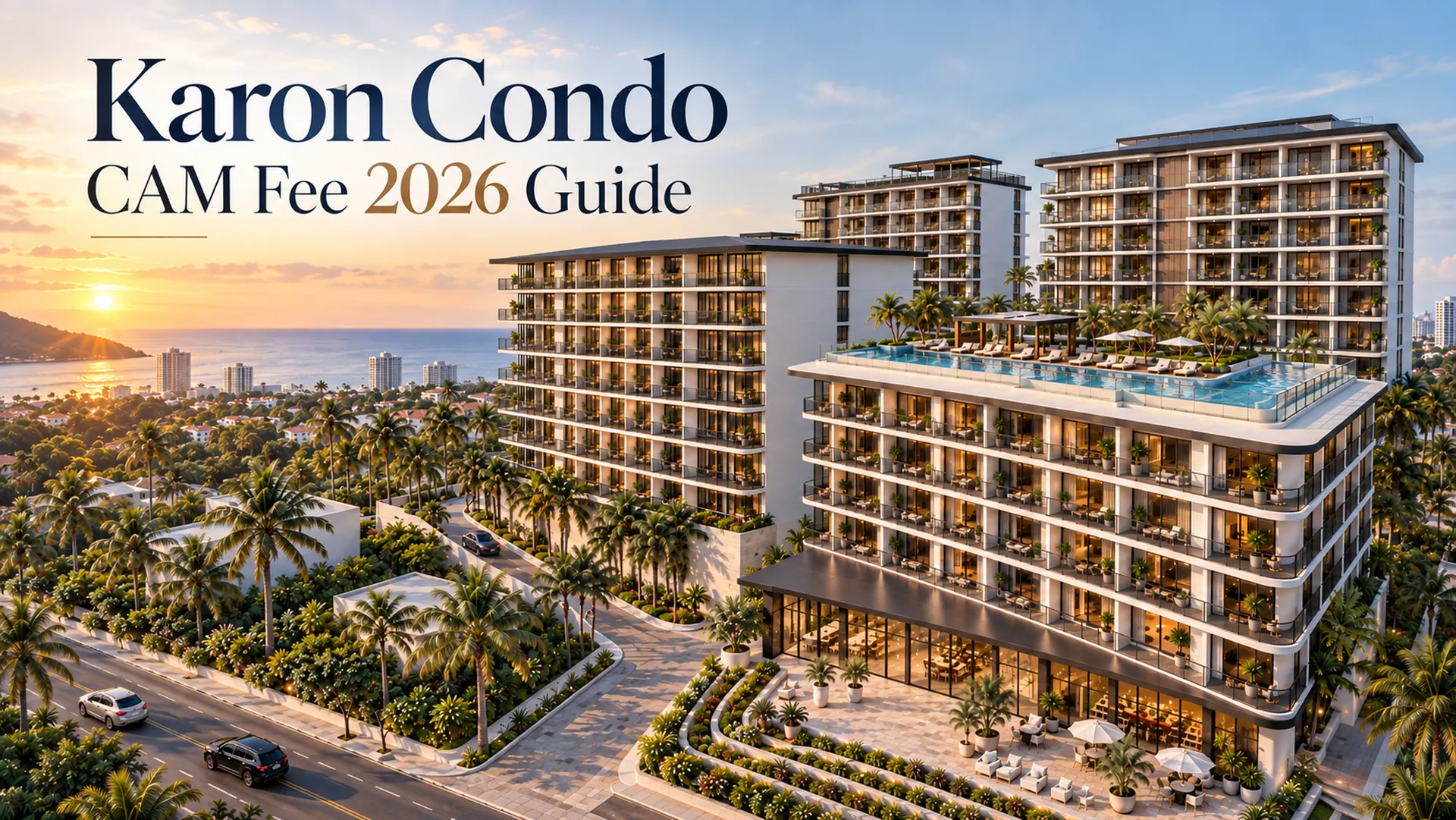
Buying a condominium in Karon is not only about the purchase price. Buyers should also understand the Karon condo CAM fee, sinking fund, transfer costs, insurance, utilities, taxes and other ongoing ownership expenses before committing to a property.
For international buyers, understanding these costs is particularly important because the total cost of ownership can affect both the long-term affordability of a condo and its potential rental return.
This guide explains the main Karon condo ownership costs to consider in 2026, how common area maintenance fees work, what owners typically pay for, and what to check before buying a condominium in Karon, Phuket.
Important: Condo fees and transaction costs can vary by project, unit size, ownership structure and the terms of the sale and purchase agreement. Always request the latest fee schedule and transaction-cost estimate before signing.
CAM stands for Common Area Maintenance.
In Thailand, condominium owners share responsibility for the costs of operating, maintaining and managing the common areas of the building. These costs are commonly referred to as the common area fee, maintenance fee or CAM fee.
Under Thailand’s Condominium Act, co-owners are responsible for shared expenses related to common services, equipment, facilities and the maintenance and operation of common property, according to the applicable ownership ratio or benefit allocation set out in the condominium regulations.
The Department of Lands guidance on condominium management explains that condominium regulations should specify the ratio used for shared expenses.
The important point for buyers is simple:
CAM is an ongoing ownership cost, not a one-time purchase expense.
Even if you do not live in the condo full-time, ownership of the unit normally means you remain responsible for applicable common-area expenses.
The exact inclusions depend on the condominium’s management structure and regulations, but a CAM fee can contribute toward the operation and maintenance of shared facilities and services.
Typical expenses may include:
The actual scope should always be checked against the project’s regulations and current management budget.
For buyers considering Ever Prime Residences in Karon, the official project website states that the maintenance fee is paid individually by condominium unit owners.

The project states that the maintenance fee covers:
Ever Prime is a low-rise condominium development in Karon with 492 units and is expected to be completed in 2028.
However, the official website does not publish a fixed current CAM rate in baht per square metre. Buyers should therefore request the latest official maintenance-fee schedule from the project or sales representative before making a financial calculation.
Ever Prime Residences official website
This is an important distinction. A buyer should never assume that the CAM fee of one Karon condominium will be the same as another project.
CAM fees are commonly calculated according to the unit’s size and the applicable rate specified by the condominium.
For example, if a condominium charges a hypothetical rate of:
THB 60 per sq.m. per month
and your unit is:
50 sq.m.
the calculation would be:
50 × THB 60 = THB 3,000 per month
or:
THB 36,000 per year
This is only an example and should not be interpreted as the actual CAM fee for a specific Karon condominium.
The actual calculation depends on the project’s approved rate and regulations.
Before purchasing, ask for the following:
One of the most important things for first-time condo buyers is understanding the difference between a CAM fee and a sinking fund.
They are not the same expense.
The CAM fee is an ongoing operating expense.
It helps pay for the regular management, maintenance and operation of the condominium’s common areas and shared services.
Think of it as the building’s ongoing operating budget.
A sinking fund is generally a reserve intended for major repairs, replacement or long-term capital expenses involving common property.
Potential examples can include:
The sinking fund is usually associated with a one-time payment or specific contribution rather than the same recurring monthly CAM payment.
However, the exact structure and amount vary by condominium.
A condo with a relatively low monthly CAM fee is not automatically cheaper to own.
You should look at:
Purchase price + CAM fee + sinking fund + transfer costs + taxes + insurance + utilities + other recurring costs
This gives you a much more realistic picture of the total ownership cost.
A sinking fund is one of the costs buyers should ask about before purchasing a new condominium.
For a new development, the sinking fund may be collected at a specified rate based on the unit size or according to the project’s payment structure.
For example, a hypothetical project could calculate a sinking fund at:
THB 500 per sq.m.
For a 50 sq.m. unit:
50 × THB 500 = THB 25,000
Again, this is only a calculation example.
Do not use a generic sinking-fund rate to calculate the actual cost of a Karon condo. Ask the project for the official figure applicable to your unit.
The CAM fee is only one part of the ownership equation.
A buyer should also consider the following expenses.
This is the obvious starting point, but buyers should avoid using the purchase price alone when comparing properties.
Two condos with the same purchase price can have very different total ownership costs depending on:
A condominium transfer normally involves a government registration fee.
Thailand’s government information portal states that the standard transfer fee for buying land or a condominium is generally calculated at 2% of the appraised value, subject to applicable rules and any temporary measures or exemptions that may be in effect.
Because government measures can change, buyers should confirm the current rate and eligibility at the time of transfer.
Thailand.go.th — Foreign Property Ownership: Fees for Condominiums
Do not automatically assume that the buyer will pay the entire transfer fee. The actual allocation between buyer and seller is often determined by the sale agreement.
Specific Business Tax, commonly known as SBT, may apply to certain property transactions.
The Revenue Department states that specific business tax for qualifying real-estate transactions is generally calculated at 3% plus local tax of 10% of the SBT, resulting in an effective rate of 3.3%, based on the applicable tax base.
Whether SBT applies depends on the nature of the transaction and seller.
Thailand Revenue Department — Real Estate Tax Guidance
For this reason, buyers should ask the seller, developer or legal adviser to provide a written estimate of the applicable transfer taxes before completion.
If specific business tax does not apply, stamp duty may apply instead.
The Revenue Department explains that stamp duty for qualifying real-estate transactions is generally calculated at 0.5% of the applicable taxable base, subject to the relevant rules.
Thailand Revenue Department — Stamp Duty Calculation
The actual tax responsibility can differ depending on the transaction, so buyers should confirm the applicable charges before transfer.
Withholding tax can also be part of the transfer calculation.
For example, the Revenue Department notes that withholding tax on certain real-estate transactions involving a juristic-person seller can be calculated at 1% of the sale price or assessed value, whichever is higher, subject to the applicable rules.
Thailand Revenue Department — Withholding Tax on Real Estate Sales
This is normally a seller-side tax consideration, but the contractual allocation of costs should always be reviewed before signing.
Property insurance is another cost that buyers should consider.
Depending on the condominium and ownership arrangement, insurance may include different levels of protection for:
The condominium’s master insurance policy may cover certain common-property risks, but that does not necessarily mean your individual unit contents or improvements are fully protected.
If you plan to furnish the unit for personal use or rental, consider whether additional contents or landlord insurance is appropriate.
Another common misunderstanding is assuming that the CAM fee covers everything.
It generally does not.
Owners may still have separate costs for:
These expenses are normally connected to the individual unit rather than the shared common areas.
For a rental property, utilities may be paid by the tenant depending on the rental agreement.
If you plan to buy a Karon condo as an investment, your ownership-cost calculation should go beyond CAM.
A rental owner may also have:
This is why gross rental income is not the same as net rental return.
For example:
Gross rental income
minus
CAM fee
minus
Management fees
minus
Cleaning and maintenance
minus
Utilities paid by owner
minus
Insurance and other costs
equals
Net operating income before financing and tax considerations
This is the number investors should pay more attention to when comparing Karon properties.
For a broader investment perspective, see our guide to Phuket condo rental yield.
Not necessarily.
A higher CAM fee can reflect a building with:
But a high fee does not automatically mean better value.
The better question is:
What am I receiving for the fee, and is the building being maintained properly?
When comparing two Karon condominiums, look at the relationship between the CAM fee and the quality and quantity of services provided.
For investors, CAM fees directly affect net operating income.
Imagine two condos both generating:
THB 40,000 per month in gross rental income.
If Condo A has lower annual operating costs than Condo B, the investor can retain more income even if both properties have the same rental revenue.
For this reason, investors should calculate:
Annual gross rent
minus
Annual CAM
minus
Property management
minus
Maintenance
minus
Insurance
minus
Other owner-paid expenses
to estimate a more realistic annual return.
This approach is more useful than comparing rental rates alone.
Foreign buyers should pay particular attention to ownership costs because the buying process may involve additional legal, banking and documentation considerations.
Foreigners can generally own qualifying condominium units in Thailand subject to the applicable legal requirements and the foreign ownership quota.
Thailand’s government guidance states that foreign ownership in a condominium cannot exceed 49% of the total space of all units in the condominium building.
Thailand.go.th — Foreign Property Ownership: Condominium Fees and Ownership
For an overview of the ownership rules, see our guide to Foreign Ownership Condo Thailand.
Foreign buyers should also make sure they understand:
A Thai property lawyer can help verify the legal and contractual details before purchase.
Before paying a reservation fee or signing a purchase agreement, ask for a complete cost sheet.
At minimum, request:
Getting these numbers before purchase makes it much easier to compare properties objectively.
Suppose an investor owns a hypothetical:
50 sq.m. condominium
and the project charges:
THB 60 per sq.m. per month
The annual CAM would be:
50 × THB 60 × 12 = THB 36,000 per year
Now assume the owner also spends:
The simplified annual operating cost would be:
THB 66,000
This example does not include rental management, taxes, financing, major repairs or other transaction-specific costs.
The purpose is to demonstrate why buyers should calculate the complete ownership budget instead of looking only at the purchase price.
Ever Prime Residences is a low-rise condominium development in Karon, Phuket, with 492 units across four eight-storey buildings.
The official project information lists facilities including a rooftop pool, swimming pools, fitness and wellness facilities, business and coworking areas, parking and other shared services.
Because a larger facility package can influence the long-term cost of operating a condominium, buyers should look beyond the headline CAM rate.
Before purchasing, ask the Ever Prime sales team for the latest:
The most important thing is to obtain these figures in writing for the specific unit you are considering.
Ever Prime Residences — Official Project Website
The answer depends on the project and the buyer’s intended use.
For an owner-occupier, CAM is one of the predictable annual costs that should be included in the household budget.
For an investor, CAM is more important because it directly reduces the amount of rental income retained by the owner.
For a foreign buyer, transaction costs and legal due diligence also need to be included in the acquisition budget.
A useful way to compare properties is therefore:
Total acquisition cost
annual ownership cost
estimated rental operating cost
=
true cost of ownership
This gives buyers a much clearer basis for comparing Karon condos.
Before buying a condominium in Karon, make sure you can answer these questions:
If you cannot answer these questions, you do not yet have a complete picture of the cost of ownership.
The Karon condo CAM fee is only one part of the total cost of owning property in Karon.
A smart buyer should consider the full picture:
Purchase price + CAM + sinking fund + transfer costs + insurance + utilities + maintenance + rental management + taxes where applicable.
For owner-occupiers, this helps create a realistic annual housing budget.
For investors, it helps calculate a more realistic net rental return.
For international buyers, it also provides a clearer understanding of the total cash required to complete and maintain the investment.
Ever Prime Residences is positioned as a large low-rise condominium development in Karon with a substantial common-area and facilities package. Before buying, prospective owners should request the latest project-specific CAM, sinking fund and transfer-cost information rather than relying on generic Phuket condo estimates.
For more information about the project, unit types and current availability, visit the Ever Prime Residences official website.
A Karon condo CAM fee is an ongoing common-area maintenance and management charge paid by condominium owners. It helps fund the operation, maintenance and management of shared areas and facilities.
It is commonly calculated according to the size of the unit and the rate established by the condominium. The exact calculation method should be confirmed in the project’s regulations and current fee schedule.
Normally, CAM covers shared building areas and services rather than electricity consumed inside an individual condominium unit. Owners should confirm the exact inclusions with the condominium management.
CAM is generally an ongoing operating and maintenance expense. A sinking fund is a reserve intended for major repairs, replacements or long-term capital expenses. The exact structure varies by condominium.
Generally, yes. Condominium owners remain responsible for applicable common-area expenses even if they do not personally occupy the unit. The Department of Lands has specifically confirmed this principle under the Condominium Act.
Yes. Ever Prime’s official website states that condominium owners individually pay a maintenance fee covering common areas, security, pest control, rubbish collection and estate management services. The current website does not publish a fixed baht-per-square-metre rate, so buyers should request the latest project-specific fee schedule.
Not necessarily. CAM is generally an ongoing ownership expense. Some developers may offer promotional periods or include certain costs as part of a sales package, so the sale agreement should be checked carefully.
Buyers should consider the purchase price, CAM, sinking fund, transfer fee, applicable taxes or stamp duty, legal costs, insurance, utilities, maintenance and any rental-management expenses.
It can be, but the answer depends on the purchase price, location, unit type, rental demand, operating costs, financing and exit strategy. Investors should calculate net rental income rather than relying only on gross rental rates.
For an international buyer, independent legal due diligence is strongly recommended. A lawyer can review the sale agreement, ownership structure, foreign quota, transfer requirements, fees and other project-specific legal matters.